Exposición de 10 ultimes obras de Secundino López-Pousa
en el aniversario de la muerte de Antonio Gaudí (1852-1926)
Homenaje a Antoni Gaudí: Un Siglo de Legado y 140 Años de Trencadís
Exhibition of 10 latest works by Secundino López-Pousa
on the anniversary of the death of Antonio Gaudí (1852-1926)
Tribute to Antoni Gaudí: A Century of Legacy and 140 Years of Trencadís
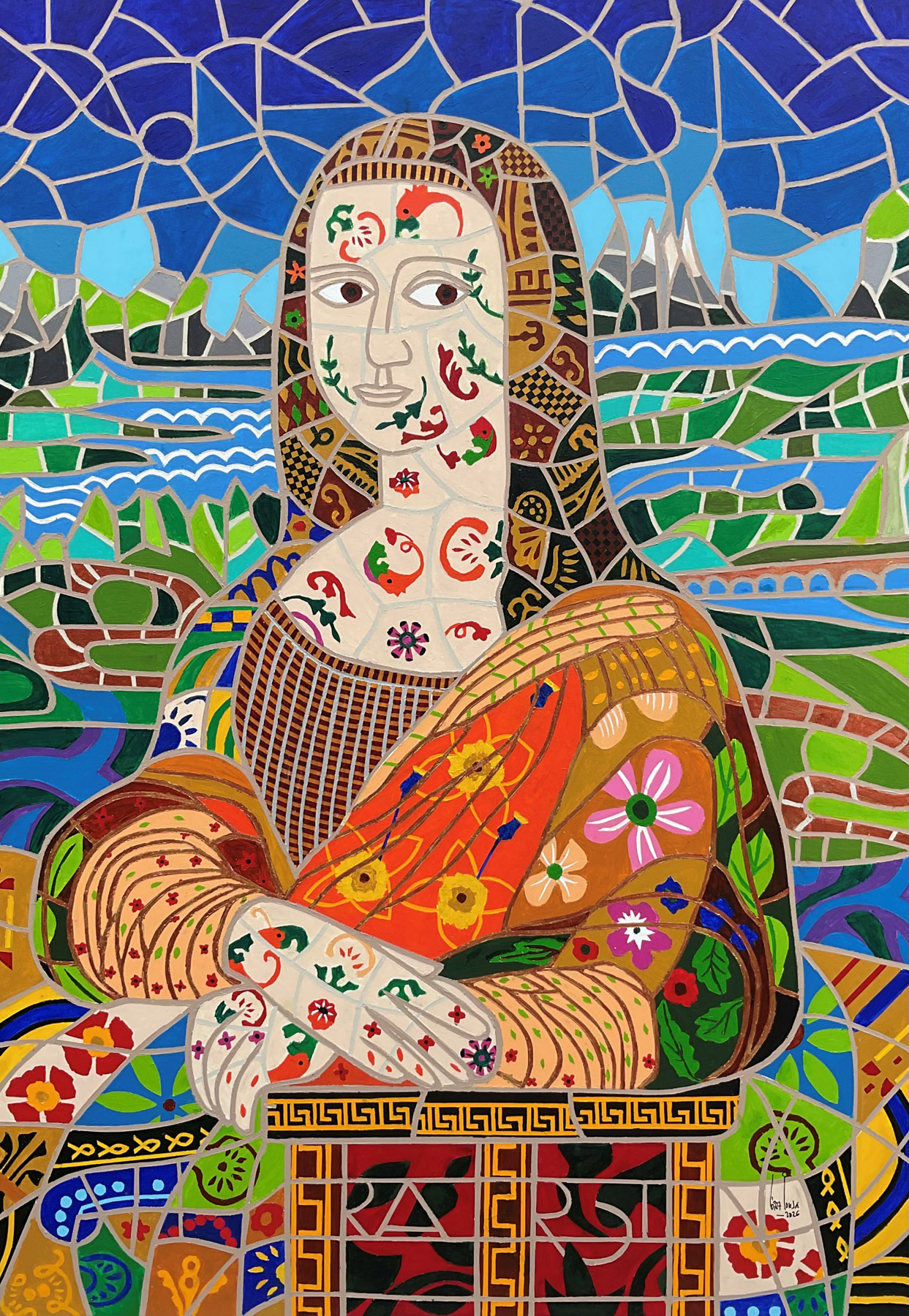
Fragmentos de Gioconda
Reinterpretación contemporánea del retrato de Lisa Gherardini en con la técnica trencadís como homenaje a Antonio Guadi en el cien aniversario.
Técnica: Acrílica
Tamaño: 73 x 59
Año: 2026
Fragments of the Mona Lisa
Contemporary reinterpretation of the portrait of Lisa Gherardini using the trencadís technique as a tribute to Antonio Gaudí on the centenary anniversary.
Technique: Acrylic
Size : 73 × 59
Year: 2026
Esta obra propone una reinterpretación contemporánea del retrato de Lisa Gherardini conocido como la Mona Lisa de Leonardo da Vinci, realizada mediante la técnica del trencadís, vinculada al lenguaje modernista desarrollado por Antoni Gaudí. La imagen del célebre retrato renacentista se reconstruye a través de una superficie fragmentada de piezas de color que transforman la serenidad tonal del original en una composición vibrante y dinámica.
Uno de los aspectos más singulares de la obra es la incorporación de pequeños motivos ornamentales —formas vegetales, símbolos y elementos decorativos— integrados en las propias piezas que configuran el rostro y el cuerpo. Esta fragmentación convierte la figura en un mosaico narrativo en el que cada elemento aporta una textura visual y simbólica distinta, ampliando la lectura del retrato hacia una dimensión lúdica y contemporánea.
El paisaje de fondo se resuelve mediante formas geométricas y ondulantes que evocan mosaicos y vitrales. Los colores intensos y las líneas fragmentadas generan una sensación de movimiento y profundidad que dialoga con la estabilidad de la figura. Asimismo, la ligera diferencia de nivel entre ambos lados del paisaje remite a la conocida ambigüedad espacial del cuadro original, manteniendo así el diálogo con las múltiples interpretaciones históricas de la obra de Leonardo.
Realizada con motivo del centenario de la muerte de Antoni Gaudí, la pieza establece un encuentro entre la tradición pictórica del Renacimiento y el lenguaje expresivo del trencadís, proponiendo una Gioconda renovada donde memoria artística y reinterpretación contemporánea conviven en una imagen luminosa y llena de vitalidad.
This work proposes a contemporary reinterpretation of the portrait of Lisa Gherardini, known as Leonardo da Vinci’s Mona Lisa, executed through the trencadís technique associated with the modernist language developed by Antoni Gaudí. The image of the renowned Renaissance portrait is reconstructed through a fragmented surface composed of colored pieces that transform the tonal serenity of the original into a vibrant and dynamic composition.
One of the most distinctive aspects of the piece is the incorporation of small ornamental motifs—vegetal forms, symbols, and decorative elements—integrated within the individual fragments that compose the face and body. This fragmentation turns the figure into a narrative mosaic in which each element contributes a distinct visual and symbolic texture, expanding the reading of the portrait toward a playful and contemporary dimension.
The background landscape is articulated through geometric and undulating forms that evoke mosaics and stained glass. Intense colors and fragmented lines generate a sense of movement and depth that contrasts with the stability of the figure. Likewise, the subtle difference in level between the two sides of the landscape alludes to the well-known spatial ambiguity of the original painting, thus maintaining a dialogue with the multiple historical interpretations of Leonardo da Vinci’s work.
Created to commemorate the centenary of the death of Antoni Gaudí, the piece establishes a meeting point between the pictorial tradition of the Renaissance and the expressive language of trencadís, proposing a renewed Gioconda in which artistic memory and contemporary reinterpretation coexist in a luminous and vital image.
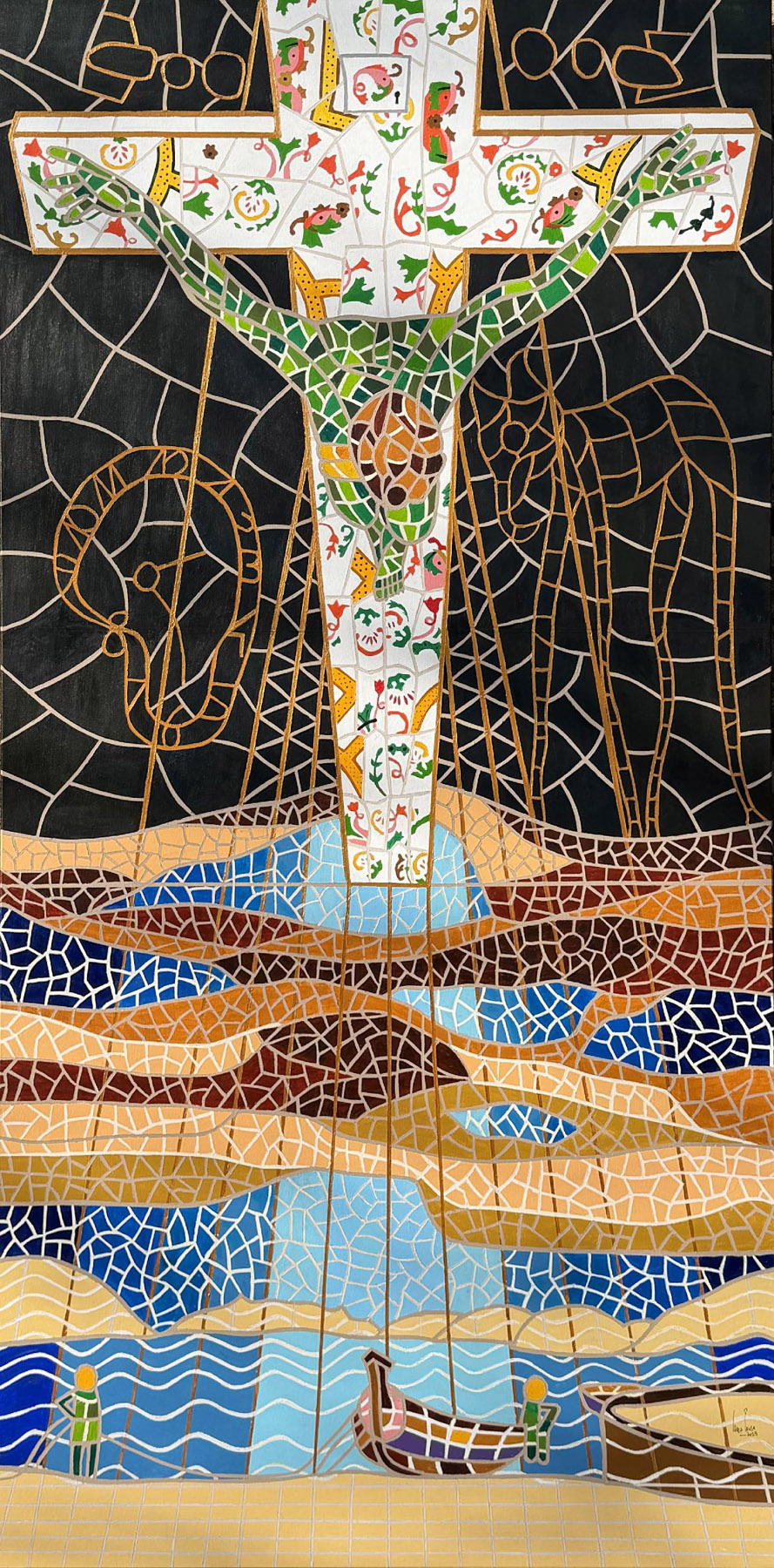
Donde la memoria se eleva (A Dalí-Gala)
Técnica: Acrílica
Tamaño 195 x 97
Año: 2025
Where Memory Rises (To Dalí–Gala)
Technique: Acrylic
Size: 195 × 97 cm
Year: 2025
Esta obra en trencadís dialoga directamente con “Cristo de San Juan de la Cruz” de Salvador Dalí, pero no se limita a reinterpretarlo, lo relee desde el territorio, la materia y el imaginario daliniano. El Cristo aparece suspendido, con los brazos abiertos, visto desde una perspectiva elevada, evocando la visión mística y cósmica que Dalí proponía, pero aquí adquiere una dimensión más terrenal gracias al mosaico fragmentado, casi arqueológico. En el la utilización del trencadís no es solo una elección técnica, sino un lenguaje conceptual, la fragmentación de la materia refleja la fragmentación de la realidad, del sueño y del subconsciente, ejes centrales en la obra de Dalí. Cada tesela actúa como una unidad de sentido, y juntas construyen una imagen que oscila entre lo sagrado y lo onírico.
El Cristo, de tonos verdes y orgánicos, parece fundirse con la naturaleza, sugiriendo una figura viva, telúrica, más cercana al paisaje que al martirio. No hay dramatismo explícito, no vemos el sufrimiento, sino la trascendencia, la suspensión del cuerpo entre el cielo y la tierra. Esto conecta con la visión daliniana de la espiritualidad como experiencia cósmica y científica.
Bajo la cruz, el paisaje de Port Lligat se despliega como un estrato de memorias, el mar ondulante, las barcas, la arena y el horizonte evocan el espacio íntimo y fundacional de Dalí. El mar actúa como símbolo del inconsciente, mientras que las barcas sugieren tránsito, viaje interior y creación.
Las figuras esquemáticas y los elementos lineales en dorado remiten a los motivos recurrentes del universo daliniano, lo arcaico, lo simbólico, lo ritual. Son presencias que no narran, sino que insinúan, dejando espacio a la interpretación, como en los sueños.
La obra no copia a Dalí, dialoga con él. Integra iconografía reconocible, pero la traduce a un lenguaje propio, mediterráneo y artesanal. El trencadís introduce tiempo, paciencia y gesto manual, en contraste con la precisión casi científica del Dalí místico, creando así una tensión muy rica entre control y azar.
Esta obra es una síntesis visual de Dalí, Portlligat y lo sagrado, construida desde la fragmentación y la memoria. Un Cristo que no domina el paisaje, sino que forma parte de él. Un homenaje que no imita, sino que interpreta, y que convierte la materia rota en un acto de creación, tal como Dalí convirtió el sueño en lenguaje.
This trencadís work enters into direct dialogue with Christ of Saint John of the Cross by Salvador Dalí, yet it does not merely reinterpret it; rather, it rereads it through the lens of territory, materiality, and the Dalinian imagination. Christ appears suspended with outstretched arms, viewed from an elevated perspective that evokes the mystical and cosmic vision proposed by Dalí. Here, however, the figure acquires a more terrestrial dimension through the fragmented, almost archaeological quality of the mosaic.
In this context, the use of trencadís is not simply a technical choice but a conceptual language. The fragmentation of matter reflects the fragmentation of reality, dreams, and the subconscious—central axes within Dalí’s work. Each tessera acts as a unit of meaning, and together they construct an image that oscillates between the sacred and the oneiric.
The Christ figure, rendered in organic green tones, appears to merge with nature, suggesting a living, telluric presence more closely linked to the landscape than to martyrdom. There is no explicit dramatization; the suffering is not shown. Instead, the emphasis lies on transcendence—the suspension of the body between heaven and earth. This approach resonates with Dalí’s vision of spirituality as both a cosmic and scientific experience.
Beneath the cross, the landscape of Portlligat unfolds as a stratum of memory. The undulating sea, boats, sand, and distant horizon evoke Dalí’s intimate and foundational environment. The sea acts as a symbol of the unconscious, while the boats suggest passage, inner journey, and creative exploration.
The schematic figures and linear golden elements recall recurring motifs within the Dalinian universe—the archaic, the symbolic, and the ritual. These presences do not narrate but rather suggest, leaving space for interpretation, much like the logic of dreams.This work does not copy Dalí; it converses with him. It integrates recognizable iconography yet translates it into a personal language that is Mediterranean and artisanal. The trencadís technique introduces time, patience, and manual gesture, in contrast with the almost scientific precision of Dalí’s mystical vision, thus creating a rich tension between control and chance.
The piece ultimately becomes a visual synthesis of Dalí, Portlligat, and the sacred, constructed through fragmentation and memory. A Christ who does not dominate the landscape but belongs to it. A tribute that does not imitate but interprets, transforming broken matter into an act of creation—just as Dalí transformed dreams into a language.
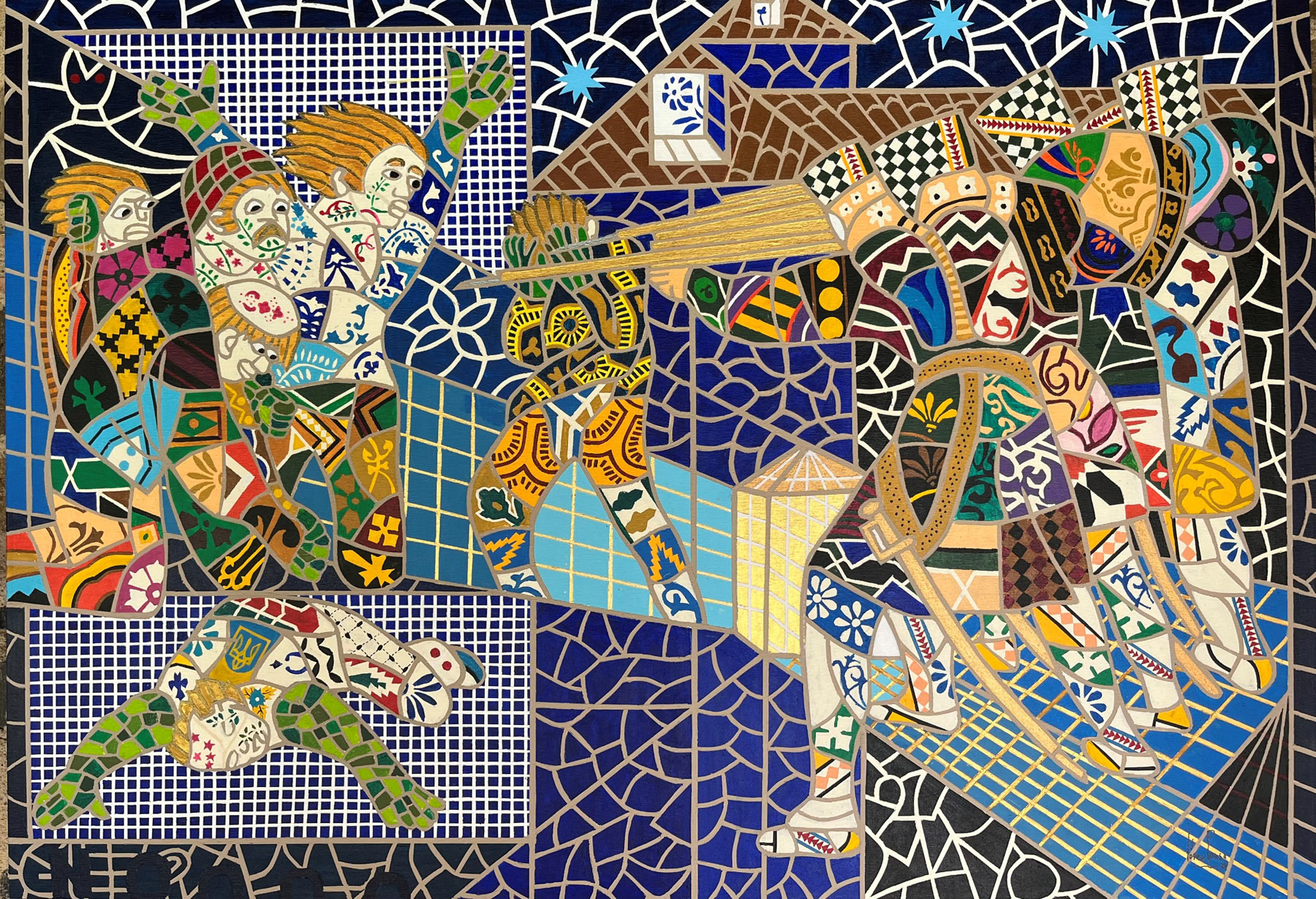
Dos de mayo a través del trencadís de Antonio Gaudí
Técnica: Acrílica
Tamaño 81 x 116
Año: 2025
The Second of May Through Antoni Gaudí’s Trencadís
Technique: Acrylic
Size: 81 × 116
Year: 2025
En el la utilización del trencadís no es solo una elección técnica, sino un lenguaje conceptual, la fragmentación de la materia refleja la fragmentación de la realidad, del sueño y del subconsciente, ejes centrales en la obra de Dalí. Cada tesela actúa como una unidad de sentido, y juntas construyen una imagen que oscila entre lo sagrado y lo onírico
La utilización de la técnica del trencadís, sirve en esta obra, para mostrar la fragmentación de la existencia y de las sociedades que enfrentan la guerra. Refleja el dolor, la muerte y la inevitable sensación de estar frente a un destino trágico, donde la vida se escapa sin razón aparente. La intención es llevar al espectador a que capte ese instante en que las personas, conscientes de su muerte inminente, sienten la impotencia y la resignación ante un final que no pueden controlar.
He seguido la obra de Francisco de Goya y como el, en la figura central, he colocado una lámpara que ilumina tanto a los que serán víctimas, como a los soldados, que son partícipes de este ciclo de violencia. La luz no solo revela, sino que pone en primer plano la vulnerabilidad de aquellos que van a morir. La figura en el suelo, separada de la escena principal, porta simbología de los pueblos de “Ucrania y Palestina”, dos naciones que actualmente sufren el peso de la guerra, la ocupación y el conflicto interminable. Este detalle pretende establecer una conexión entre los eventos históricos que inspiran el cuadro y las tragedias contemporáneas.
El cuadro se organiza en tres elementos principales: en el centro, se representa la ciudad, con tejados que albergan ventanas iluminadas y ramas que simbolizan la esperanza. Las ventanas son aperturas a la vida y los sueños de quienes, bajo un techo protector, aún confían en un futuro mejor, aunque lo frágil de esa esperanza está presente. A la derecha, los soldados, con sus rifles apuntando, encarnan la fuerza opresora y la fatalidad inminente. Están listos para disparar, insensibles al sufrimiento que causan, deshumanizados por la guerra y el poder. A la izquierda las figuras que se enfrentan a la muerte muestran consternación y miedo, expresado en el color de sus cabellos y en sus miradas vacías. Bajo sus pies, casi apartado del mundo, yace un cadáver, un símbolo del destino que pronto compartirán. Sobre él, los que van a morir se mantienen de pie, todavía conscientes, pero inevitablemente condenados. Entre ellos y los soldados, aparece una figura aterrorizada que se oculta el rostro con las manos, un espectador pasivo que representa a todos nosotros, a quienes observamos la tragedia, impotentes, sin intervenir.
El cuadro no solo es una reinterpretación de un hecho histórico, sino también un grito de protesta ante las injusticias actuales. Es un reflejo del sufrimiento colectivo y de cómo las guerras siguen arrasando con la humanidad, dejando tras de sí un rastro de muerte, dolor y pérdida, mientras la esperanza se aferra, frágil, a la vida que queda.
In this work, the use of trencadís is not merely a technical choice but a conceptual language. The fragmentation of the material reflects the fragmentation of reality, of dreams, and of the subconscious—central themes in the work of Dalí. Each tessera acts as a unit of meaning, and together they construct an image that oscillates between the sacred and the dreamlike.
The use of the trencadís technique in this piece serves to portray the fragmentation of existence and of societies that face war. It reflects pain, death, and the inevitable feeling of standing before a tragic destiny, where life escapes without apparent reason. The intention is to lead the viewer to capture that moment when people, aware of their imminent death, feel the helplessness and resignation of facing an end they cannot control.
I have followed the work of Francisco de Goya and, like him, in the central figure I have placed a lamp that illuminates both those who will become victims and the soldiers who are participants in this cycle of violence. The light not only reveals but also brings to the foreground the vulnerability of those who are about to die. The figure lying on the ground, separated from the main scene, carries symbols of the peoples of Ukraine and Palestine—two nations currently bearing the weight of war, occupation, and endless conflict. This detail seeks to establish a connection between the historical events that inspire the painting and contemporary tragedies.
The painting is organized around three main elements. In the center, the city is represented, with rooftops that contain illuminated windows and branches that symbolize hope. The windows are openings to the lives and dreams of those who, beneath a protective roof, still trust in a better future, even though the fragility of that hope remains present. On the right, the soldiers, with their rifles aimed, embody oppressive force and the imminence of fate. They are ready to shoot, insensitive to the suffering they cause, dehumanized by war and power. On the left, the figures facing death show consternation and fear, expressed through the color of their hair and their empty gazes. Beneath their feet, almost removed from the world, lies a corpse—a symbol of the destiny they will soon share. Above him, those who are about to die remain standing, still conscious but inevitably condemned. Between them and the soldiers appears a terrified figure covering their face with their hands, a passive spectator who represents all of us—those who observe tragedy helplessly, without intervening.
The painting is not only a reinterpretation of a historical event but also a cry of protest against present-day injustices. It reflects collective suffering and how wars continue to devastate humanity, leaving behind a trail of death, pain, and loss, while hope clings—fragile yet persistent—to the life that remains.
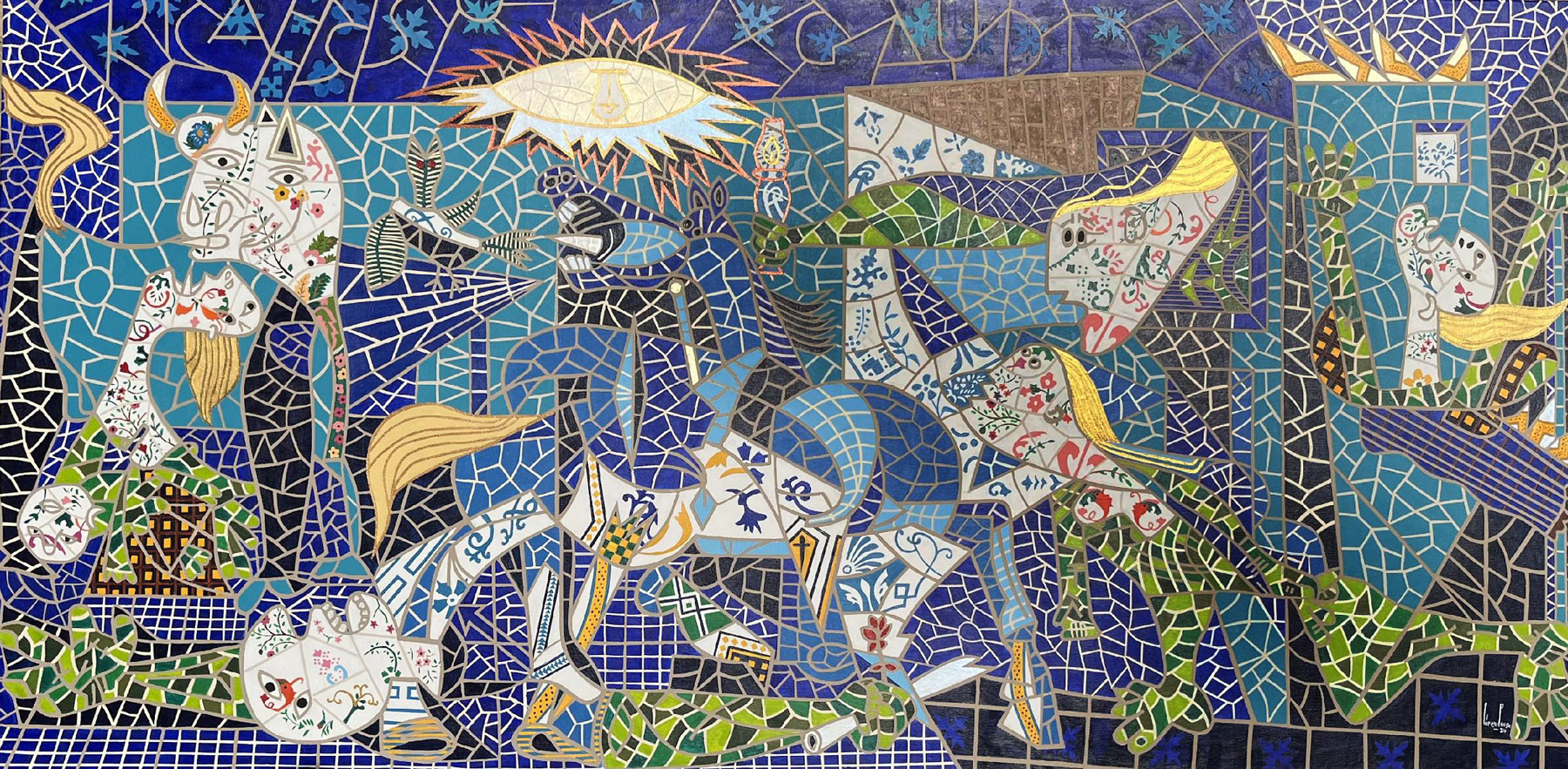
El Cubismo de Pablo Picasso a través del Trencadís de Antonio Gaudí
Técnica: Acrílica
Tamaño 97 x 195
Año: 2025
Pablo Picasso’s Cubism Through Antoni Gaudí’s Trencadís
Technique: Acrylic
Size: 97 × 195 cm
Year: 2025
Esta obra está dedicada a dos genios del arte: Antonio Gaudí (1852-1926) y Pablo Picasso (1881-1973). Gaudí fue pionero en el uso de la técnica del trencadís en los pabellones de la Finca Güell en el barrio de Pedralbes, Barcelona, entre 1883 y 1887. Picasso, por su parte, residió en Barcelona desde 1885 hasta 1904, antes de trasladarse a París. Ambos artistas coincidieron en el tiempo, y existen referencias que mencionan la admiración de Picasso por la arquitectura de Gaudí.
El trabajo titulado «El cubismo de Pablo Picasso a través del trencadís de Antonio Gaudí» busca fusionar aspectos fundamentales de la creatividad de estos dos artistas. En 1937, Picasso pintó el Guernica, una obra en tonalidades negras y grises que transmite el sentido trágico de la guerra. La pintura muestra tres animales: un toro, un caballo herido y un pájaro alado, así como varios seres humanos. A la derecha, una figura femenina eleva sus brazos en un gesto de desesperación frente a una casa en llamas; otra mujer observa la escena desde una ventana, sosteniendo una lámpara en su mano extendida. A la izquierda, una madre afligida sostiene a su hijo sin vida. En la parte superior de la obra, una gran lámpara ilumina la escena.
Guernica encapsula los símbolos del ciclo dedicado a la Minotauromaquia de Picasso, quien estaba fascinado por la mitología griega como expresión de la dualidad inherente al ser humano. Esta dualidad se manifiesta en el mito, tanto como monstruosidad oculta, como en la naturaleza humana dividida entre la instintividad y la racionalidad.
En 1885, cuando Picasso llegó a Barcelona, Gaudí estaba diseñando los jardines de la Finca Güell. En la entrada, Gaudí da vida a un Dragón (Ladón), una referencia esencial al poema «L’Atlàntida» de Jacint Verdaguer. Esta obra, basada en una historia mitológica, narra las peripecias del héroe griego condenado a realizar doce trabajos colosales. Uno de estos trabajos era conseguir las manzanas de oro, frutos de un árbol en el Jardín de las Hespérides que otorgaban la inmortalidad. El árbol estaba custodiado por tres doncellas y el dragón Ladón. Ladón fue encadenado y convertido en la constelación del dragón como castigo por no cumplir su misión, y las doncellas fueron transformadas en un chopo, un sauce y un olmo.
Un año más tarde, Gaudí inició la obra del Palau Güell (1886-1890), concebido como vivienda, que incluye diez chimeneas. Aunque su significado es desconocido, es posible que sean una prolongación de la cultura mitológica. Una chimenea destaca particularmente por su color y forma: la chimenea número 3. Esta estructura se distingue notablemente del resto de las pirámides circundantes por su llamativo color verde y su peculiar silueta, evocando la imagen de un árbol. La elección del tono verde no es accidental, sino que parece llevar un simbolismo profundo y enigmático. Aunque se desconocen las razones precisas detrás de la elección de esta forma y color, podemos especular que el simbolismo podría estar relacionado con el tejo, un árbol venerado en la mitología y cultura céltica. El tejo era considerado sagrado, asociado con la muerte y la reencarnación.
En la obra de Gaudí, esta conexión entre el tejo y su simbolismo adquiere una dimensión particularmente intrigante. Ignacio Abella describe al tejo como un ser misterioso y profundo, vinculado a los rituales funerarios y el tránsito hacia el más allá. Relacionando este simbolismo con la tauromaquia y los temas de pasión y muerte en la obra de Picasso, podemos interpretar que los colores verdes en las figuras que sufren y mueren en las obras de Picasso dan vida a sus sentimientos y creencias ancestrales.
This work is dedicated to two geniuses of art: Antoni Gaudí (1852–1926) and Pablo Picasso (1881–1973). Gaudí was a pioneer in the use of the trencadís technique in the pavilions of the Finca Güell in the Pedralbes district of Barcelona between 1883 and 1887. Picasso, for his part, lived in Barcelona from 1885 until 1904, before moving to Paris. Both artists lived during the same period, and there are references that mention Picasso’s admiration for Gaudí’s architecture.
The work titled “Pablo Picasso’s Cubism Through Antoni Gaudí’s Trencadís” seeks to merge fundamental aspects of the creativity of these two artists. In 1937, Picasso painted Guernica, a work in black and gray tones that conveys the tragic sense of war. The painting shows three animals: a bull, a wounded horse, and a winged bird, as well as several human figures. On the right, a female figure raises her arms in a gesture of despair before a burning house; another woman observes the scene from a window, holding a lamp in her outstretched hand. On the left, a grieving mother holds her lifeless child. At the top of the work, a large lamp illuminates the scene.
Guernica encapsulates the symbols of the cycle dedicated to Picasso’s Minotauromachy, as the artist was fascinated by Greek mythology as an expression of the duality inherent in human beings. This duality appears in the myth both as hidden monstrosity and as the human condition divided between instinct and reason.
In 1885, when Picasso arrived in Barcelona, Gaudí was designing the gardens of the Finca Güell. At the entrance, Gaudí brings to life a Dragon (Ladon), an essential reference to the poem L’Atlàntida by Jacint Verdaguer. This work, based on a mythological story, recounts the adventures of the Greek hero condemned to perform twelve colossal labors. One of these tasks was to obtain the golden apples, fruits from a tree in the Garden of the Hesperides that granted immortality. The tree was guarded by three maidens and the dragon Ladon. Ladon was chained and turned into the constellation of the dragon as punishment for failing in his mission, and the maidens were transformed into a poplar, a willow, and an elm.
One year later, Gaudí began work on the Palau Güell (1886–1890), conceived as a residence and featuring ten chimneys. Although their meaning is unknown, they may represent an extension of mythological culture. One chimney stands out particularly for its color and form: chimney number 3. This structure differs notably from the surrounding pyramids because of its striking green color and peculiar silhouette, evoking the image of a tree. The choice of the green tone does not seem accidental, but rather suggests a deep and enigmatic symbolism. Although the precise reasons behind the choice of this form and color remain unknown, we may speculate that the symbolism could be related to the yew tree, a tree revered in Celtic mythology and culture. The yew was considered sacred, associated with death and rebirth.
In Gaudí’s work, this connection between the yew tree and its symbolism acquires a particularly intriguing dimension. Ignacio Abella describes the yew as a mysterious and profound being, linked to funeral rituals and the passage to the afterlife. By relating this symbolism to bullfighting and to the themes of passion and death present in Picasso’s work, we may interpret that the green tones in the figures who suffer and die in Picasso’s works give life to their ancestral feelings and beliefs.
.
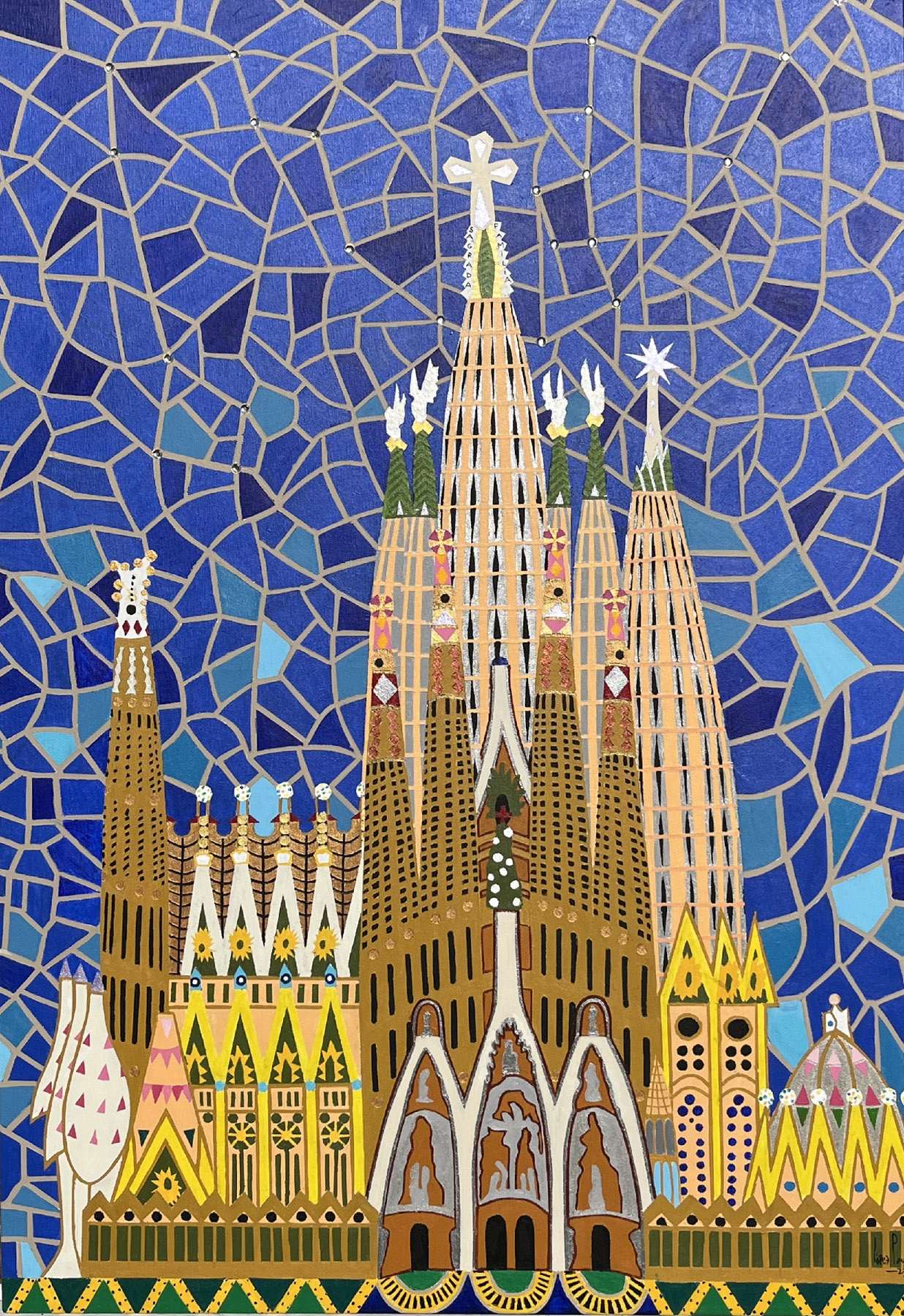
Mitología y espiritualidad en el entrono de la Sagrada Familia
Técnica: Acrílica
Tamaño: 116 x 81
Año: 2024
Mythology and Spirituality in the Surroundings of the Sagrada Familia
Technique: Acrylic
Size : 116×81
Year: 2024
Gaudí, en una de sus primeras obras para la familia Güell, diseño el muro de la puerta de entrada a la propiedad de la Finca Güell (1884) y los jardines, así como pequeños edificios. En ellos emplearía por primera vez el trencadís. En la verja de la puerta realizo la figura de un Dragón para dar vida a la leyenda de Ladón, y al jardín de las Hespérides, y dejó constancia de sus conocimientos e interés por la astronomía, dejando grabadas las constelaciones de Draco, la Osa mayor y Menor.
Esta pintura realiza una composición en trencadís inspirada en la obra más singular de Antoni Gaudí, la Sagrada Familia, reinterpretada desde una mirada simbólica y espiritual. Tradicionalmente descrita como un bosque de piedra, en esta obra el templo se concibe más bien como una antesala del cielo, un espacio de tránsito entre lo terrenal y lo trascendente, definido por su luminosidad, verticalidad y riqueza ornamental.
Las torres se elevan como ejes de conexión entre la tierra y el universo. Sus formas orgánicas, recubiertas de fragmentos cromáticos, evocan tanto la naturaleza como la arquitectura sagrada, fundiendo materia y espíritu. El uso del trencadís refuerza esta idea de construcción a partir de lo fragmentado, donde cada pieza contribuye a un todo armónico, vibrante y lleno de sentido.
El fondo azul profundo actúa como un firmamento simbólico. Sobre él, pequeños puntos brillantes trazan las constelaciones de Draco, la Osa Mayor y la Osa Menor, estableciendo un diálogo directo con el cosmos. Estas constelaciones no aparecen únicamente como un recurso estético, sino como una referencia al inicio de una filosofía vital: el tránsito de lo pagano hacia la luz espiritual, de la observación ancestral del cielo a una conciencia de conexión universal.
La obra propone así una lectura ascensional. Desde la base terrenal del templo hasta la culminación de las torres, el espectador es invitado a elevar la mirada y el pensamiento, atravesando símbolos, ornamentos y figuras que conducen hacia una dimensión espiritual. La arquitectura se transforma en un puente cósmico, y el templo, más que un edificio, se revela como un canal de comunicación entre el ser humano y el universo.
En este sentido, la pintura no solo rinde homenaje a Gaudí y a su visión profundamente mística de la naturaleza y la arquitectura, sino que plantea una reflexión sobre la luz, la trascendencia y la pertenencia del ser humano al orden cósmico.
Gaudí, in one of his earliest works for the Güell family, designed the wall of the entrance gate to the Finca Güell estate (1884), as well as its gardens and several small buildings. In these works he used the trencadís technique for the first time. In the gate’s ironwork he created the figure of a Dragon to bring to life the legend of Ladon and the Garden of the Hesperides, while also demonstrating his knowledge of and interest in astronomy by engraving the constellations Draco, Ursa Major, and Ursa Minor.
This painting presents a trencadís composition inspired by the most singular work of Antoni Gaudí, the Sagrada Familia, reinterpreted through a symbolic and spiritual perspective. Traditionally described as a forest of stone, in this work the temple is conceived rather as a threshold to the heavens, a space of transition between the earthly and the transcendent, defined by its luminosity, verticality, and ornamental richness.
The towers rise as axes of connection between the earth and the universe. Their organic forms, covered with chromatic fragments, evoke both nature and sacred architecture, merging matter and spirit. The use of trencadís reinforces this idea of construction from fragmentation, where each piece contributes to a harmonious, vibrant, and meaningful whole.
The deep blue background acts as a symbolic firmament. Upon it, small luminous points trace the constellations Draco, Ursa Major, and Ursa Minor, establishing a direct dialogue with the cosmos. These constellations do not appear merely as an aesthetic resource but as a reference to the beginning of a vital philosophy: the transition from the pagan to spiritual light, from the ancestral observation of the sky to an awareness of universal connection.
The work thus proposes an ascending interpretation. From the earthly base of the temple to the culmination of the towers, the viewer is invited to raise both gaze and thought, passing through symbols, ornaments, and forms that lead toward a spiritual dimension. The architecture transforms into a cosmic bridge, and the temple, more than a building, reveals itself as a channel of communication between the human being and the universe.
In this sense, the painting not only pays homage to Gaudí and his profoundly mystical vision of nature and architecture, but also offers a reflection on light, transcendence, and humanity’s belonging to the cosmic order.
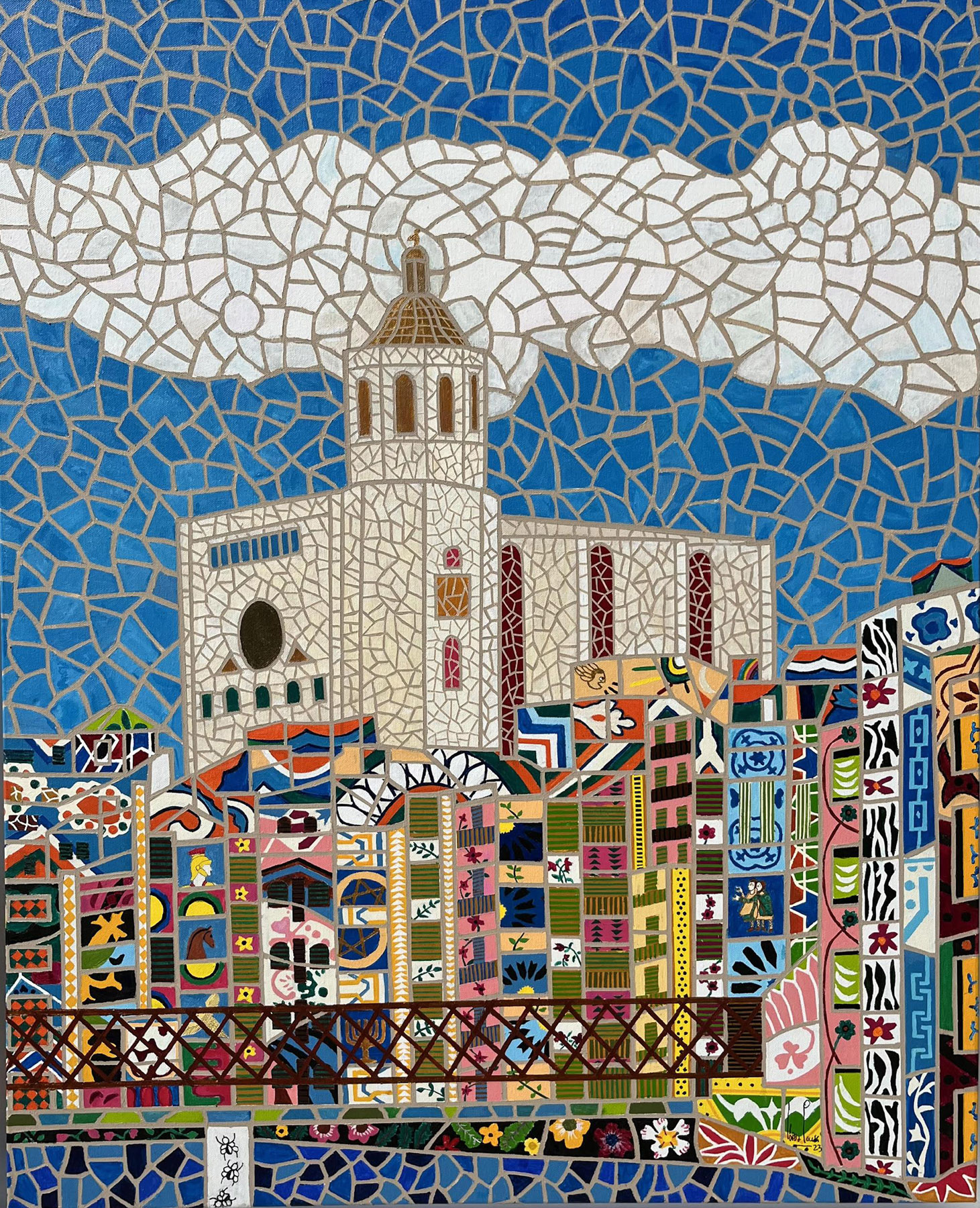
Los secretos de Girona
Técnica: Acrílica
Tamaño: 100 x 81
Año: 2023
The Secrets of Girona
Technique: Acrylic
Size : 100×81
Year: 2023
Esta obra se realiza siguiendo la técnica del “trencadís” característica del modernismo catalán y popularizada por Antoni Gaudí, en la que fragmentos irregulares se ensamblan para construir una imagen unitaria, rica en textura y simbolismo. A través de esta técnica, la pintura representa una visión singular de la Catedral de Santa María de Girona, situada en el corazón del casco antiguo de Girona, dentro del recinto histórico conocido como la Força Vella. Este espacio coincide con el trazado urbano de la antigua Gerunda, asentamiento romano sobre el que se desarrolló la ciudad medieval.
La composición presenta la catedral elevándose de manera monumental, mientras que, bajo el entramado del trencadís, se intuye el curso del río Oñar, eje natural y simbólico de la ciudad, así como el emblemático puente Puente de Hierro, o de las Pescaderas Viejas o de Eiffel, conocido es por dos motivos: su estructura metálica de color rojo que fue construido en 1876 elemento de unión entre barrios y épocas. El uso del mosaico fragmentado permite integrar múltiples capas narrativas: escenas, símbolos y referencias que invitan a una lectura pausada y atenta de la obra.
Entre estos detalles se descubren alusiones a la cábala judía, en recuerdo de la importante comunidad hebrea que habitó Girona; a las moscas de Sant Narcís, símbolo legendario de protección de la ciudad; a los “manaies”, soldados romanos que aún hoy aparecen representados en procesiones tradicionales; y a la fiesta de Temps de Flors, cuando la ciudad se transforma con intervenciones florales efímeras. Cada fragmento actúa como una pequeña historia visual, integrada en un conjunto mayor.
De este modo, la pintura no solo representa un paisaje urbano, sino que se convierte en un mapa simbólico de la memoria colectiva de Girona. A través del trencadís, la obra invita al espectador a descubrir sus secretos, recorriendo visualmente su historia, sus tradiciones y su identidad cultural, fragmento a fragmento, como si se tratara de un paseo íntimo por la ciudad.
This work is created using the trencadís technique, characteristic of Catalan Modernism and popularized by Antoni Gaudí, in which irregular fragments are assembled to construct a unified image rich in texture and symbolism. Through this technique, the painting presents a unique vision of the Cathedral of Santa Maria of Girona, located in the heart of Girona’s old town, within the historic area known as the Força Vella. This space corresponds to the urban layout of ancient Gerunda, the Roman settlement upon which the medieval city later developed.
The composition shows the cathedral rising monumentally, while beneath the network of trencadís one can sense the course of the Onyar River, the natural and symbolic axis of the city, as well as the emblematic Iron Bridge—also known as the Old Fishmongers’ Bridge or the Eiffel Bridge—famous for two reasons: its red metal structure and the fact that it was built in 1876, serving as a link between neighborhoods and historical periods. The use of fragmented mosaic allows multiple narrative layers to be integrated: scenes, symbols, and references that invite a slow and attentive reading of the work.
Among these details are references to Jewish Kabbalah, recalling the important Hebrew community that once lived in Girona; the flies of Saint Narcissus, the legendary symbol of the city’s protection; the manaies, Roman soldiers who are still represented today in traditional processions; and the Temps de Flors festival, when the city is transformed through ephemeral floral installations. Each fragment acts as a small visual story, integrated into a greater whole.
In this way, the painting does not simply represent an urban landscape but becomes a symbolic map of Girona’s collective memory* Through the trencadís, the work invites the viewer to discover its secrets, visually traveling through its history, traditions, and cultural identity—fragment by fragment, as if it were an intimate walk through the city.
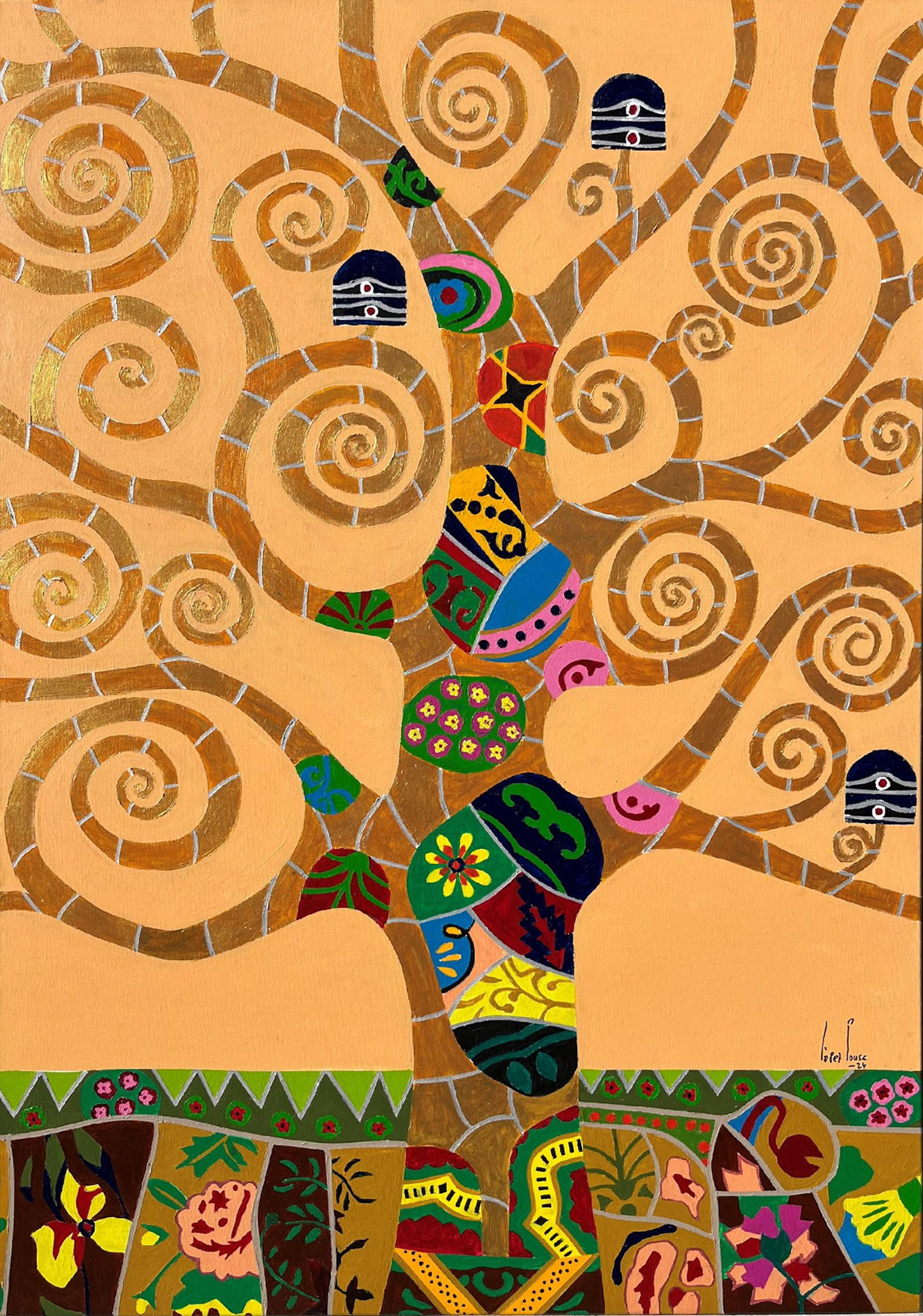
Trencadís de Antonio Gaudí y el Árbol de la Vida de Gustav Klimt
Técnica: Acrílica
Tamaño: 100 x 70
Año: 2024
Antoni Gaudí’s Trencadís and Gustav Klimt’s Tree of Life
Technique: Acrylic
Size : 100×70
Year: 2024
Esta obra establece un diálogo visual entre dos lenguajes artísticos icónicos: el simbolismo ornamental de “El Árbol de la Vida” de Gustav Klimt y la técnica del trencadís desarrollada por Antoni Gaudí, emblema del modernismo catalán. La composición surge como un homenaje a ambas influencias, integrando la riqueza decorativa y simbólica de Klimt con la fragmentación expresiva del trencadís, técnica que celebra la reconstrucción, la diversidad y la profunda conexión con la naturaleza.
El árbol central, eje visual y conceptual de la obra, despliega sus ramas en formas espirales que evocan directamente el universo klimtiano. Estas espirales, cargadas de movimiento y ritmo, sugieren un flujo continuo de energía vital, crecimiento y eternidad. Al mismo tiempo, el tronco y las ramas se construyen a partir de fragmentos cromáticos que remiten al trencadís de Gaudí: piezas irregulares ensambladas en curvas orgánicas, donde conviven motivos florales, geométricos y abstractos, en clara alusión a las superficies decorativas del Park Güell.
La paleta cromática combina los dorados y ocres característicos de Klimt —símbolos de lo sagrado, lo eterno y lo espiritual— con los colores vibrantes y contrastantes del trencadís. Esta fusión genera una composición rica en texturas y matices visuales. El uso de fragmentos no solo cumple una función estética, sino también simbólica: representa la idea de reconstrucción y de unidad a partir de lo diverso y lo aparentemente fragmentado.
Así, el árbol se convierte en un símbolo universal de vida, conexión y renovación. Los colores y patrones celebran la diversidad cultural y artística, integrando la herencia mediterránea de Gaudí con el simbolismo atemporal del Árbol de la Vida de Klimt, dando lugar a una obra que dialoga entre tradición, modernidad y espiritualidad.
This work establishes a visual dialogue between two iconic artistic languages: the ornamental symbolism of Gustav Klimt’s The Tree of Life and the trencadís technique developed by Antoni Gaudí, an emblem of Catalan Modernism. The composition emerges as a tribute to both influences, integrating Klimt’s decorative and symbolic richness with the expressive fragmentation of *trencadís*, a technique that celebrates reconstruction, diversity, and a profound connection with nature
The central tree, the visual and conceptual axis of the work, unfolds its branches in spiral forms that directly evoke the Klimtian universe. These spirals, full of movement and rhythm, suggest a continuous flow of vital energy, growth, and eternity. At the same time, the trunk and branches are constructed from chromatic fragments that recall Gaudí’s trencadís: irregular pieces assembled into organic curves, where floral, geometric, and abstract motifs coexist, clearly alluding to the decorative surfaces of Park Güell.
The color palette combines Klimt’s characteristic golds and ochres—symbols of the sacred, the eternal, and the spiritual—with the vibrant and contrasting colors of trencadís. This fusion creates a composition rich in textures and visual nuances. The use of fragments fulfills not only an aesthetic function but also a symbolic one: it represents the idea of reconstruction and unity emerging from diversity and apparent fragmentation.
Thus, the tree becomes a universal symbol of life, connection, and renewal. The colors and patterns celebrate cultural and artistic diversity, merging Gaudí’s Mediterranean heritage with the timeless symbolism of Klimt’s Tree of Life, giving rise to a work that creates a dialogue between tradition, modernity, and spirituality.
A Pau Gil Serra que hizo posible la construcción del hospital Sant Pau
Técnica: Acrílica
Tamaño: 60 x 80
Año: 2025
Thanks to Pau Gil Serra, who made the construction of the Hospital de Sant Pau possible
Technique: Acrylic
Size : 60 x 80
Year: 2025
Esta obra ha sido realizada con la técnica del trencadís, impulsada por Antoni Gaudí. En la pintura, se observa un retrato compuesto por múltiples fragmentos de diferentes colores y patrones, evocando los mosaicos de las paredes y vidrieras del hospital que fueron ampliamente utilizadas en el Hospital de Sant Pau por Lluís Domènech i Montaner.
La figura central simboliza a Pau Gil Serra, benefactor cuya contribución económica hizo posible la construcción del hospital. Representa, además, una alegoría de la beneficencia y la medicina. Los colores vibrantes y la composición geométrica remiten a los vitrales y mosaicos del Hospital de Sant Pau, reforzando su conexión con la arquitectura modernista y la simbología del arte como medio para la sanación y el bienestar social.
La técnica del mosaico se ha empleado como una metáfora de la interconexión entre el pasado y el presente, entre el esfuerzo individual y su impacto colectivo. Los patrones y colores están vinculados con símbolos de fe, caridad y tradición catalana, reforzando el significado histórico y cultural del hospital. La simetría y los elementos decorativos sugieren un mensaje de equilibrio y trascendencia, destacando la armonía entre arte, historia y legado.
This work has been created using the trencadís technique, promoted by Antoni Gaudí. In the painting, a portrait composed of multiple fragments of different colors and patterns can be observed, evoking the mosaics of the walls and stained-glass windows that were widely used in the Hospital de Sant Pau by Lluís Domènech i Montaner.
The central figure symbolizes Pau Gil Serra, the benefactor whose financial contribution made the construction of the hospital possible. It also represents an allegory of charity and medicine. The vibrant colors and geometric composition recall the stained glass and mosaics of the Hospital de Sant Pau, reinforcing its connection with Modernist architecture and the symbolism of art as a means for healing and social well-being.
The mosaic technique has been used as a metaphor for the interconnection between past and present, between individual effort and its collective impact. The patterns and colors are linked to symbols of faith, charity, and Catalan tradition, reinforcing the historical and cultural significance of the hospital. The symmetry and decorative elements suggest a message of balance and transcendence, highlighting the harmony between art, history, and legacy.
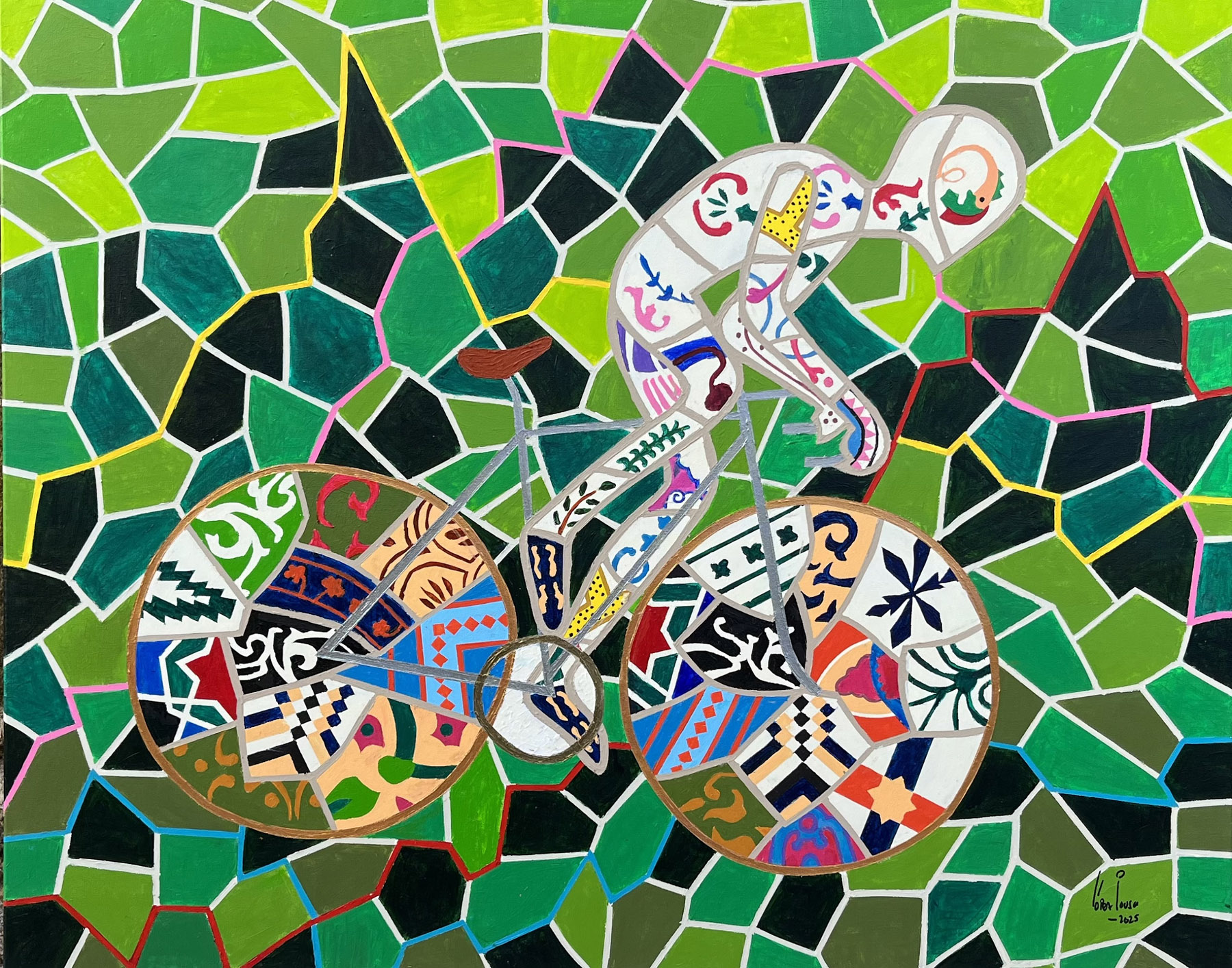
Ciclista y montaña
Técnica: Acrílica
Tamaño 65 x 81
Año: 2025
Cyclist and Mountain
Technique: Acrylic
Size: 65 × 81 cm
Year: 2025
Esta obra rinde homenaje a los ciclistas y sus logros, reflejando la pasión, el esfuerzo y la dedicación que definen este deporte. Realizada con la técnica del trencadís, transmite una conexión simbólica con el recorrido fragmentado pero cohesivo que enfrentan los ciclistas en su trayecto. A través de múltiples fragmentos (colores, culturas y paisajes), la obra se ensambla en una composición unificada, evocando el dinamismo y la energía propios del ciclismo.
La fragmentación de los colores y patrones genera una sensación de movimiento continuo, capturando la esencia del deporte. La incorporación de los tonos de los maillots de las grandes vueltas ciclistas (España, Francia, Italia y Bélgica) refuerza el vínculo con el ciclismo profesional, destacando su diversidad y universalidad como disciplina que conecta países y tradiciones.
El ciclista, representado de forma estilizada, está compuesto por patrones florales y geométricos que evocan dinamismo y diversidad cultural. Su postura inclinada, concentrada en avanzar, simboliza la determinación y el sacrificio inherentes al ciclismo, mientras que el equilibrio de colores y patrones aporta una sensación de belleza y armonía en la práctica del deporte. Esta representación trasciende la individualidad, convirtiéndose en un símbolo universal del esfuerzo colectivo que caracteriza al ciclismo.
Las ruedas de la bicicleta, decoradas con mosaicos vibrantes, aluden a la riqueza cultural y paisajística de las regiones donde se desarrollan las grandes vueltas. Por su parte, el fondo verde fragmentado, con sus variaciones de tonos claros y oscuros, evoca paisajes naturales como montañas, campos y colinas, típicos de las rutas ciclistas. Este fondo no solo sugiere movimiento, sino también una profunda conexión con la naturaleza, uno de los elementos esenciales de este deporte.
This work pays tribute to cyclists and their achievements, reflecting the passion, effort, and dedication that define this sport. Created using the trencadís technique, it conveys a symbolic connection with the fragmented yet cohesive journey that cyclists face along their route. Through multiple fragments (colors, cultures, and landscapes), the work comes together in a unified composition, evoking the dynamism and energy characteristic of cycling.
The fragmentation of colors and patterns creates a sensation of continuous movement, capturing the essence of the sport. The incorporation of the colors of the jerseys from the major cycling tours (Spain, France, Italy, and Belgium) reinforces the connection with professional cycling, highlighting its diversity and universality as a discipline that connects countries and traditions.
The cyclist, represented in a stylized way, is composed of floral and geometric patterns that evoke dynamism and cultural diversity. His forward-leaning posture, focused on moving ahead, symbolizes the determination and sacrifice inherent in cycling, while the balance of colors and patterns brings a sense of beauty and harmony to the practice of the sport. This representation transcends individuality, becoming a universal symbol of the collective effort that characterizes cycling.
The wheels of the bicycle, decorated with vibrant mosaics, allude to the cultural and landscape richness of the regions where the great tours take place. Meanwhile, the fragmented green background, with its variations of light and dark tones, evokes natural landscapes such as mountains, fields, and hills, typical of cycling routes. This background not only suggests movement but also a deep connection with nature, one of the essential elements of this sport.
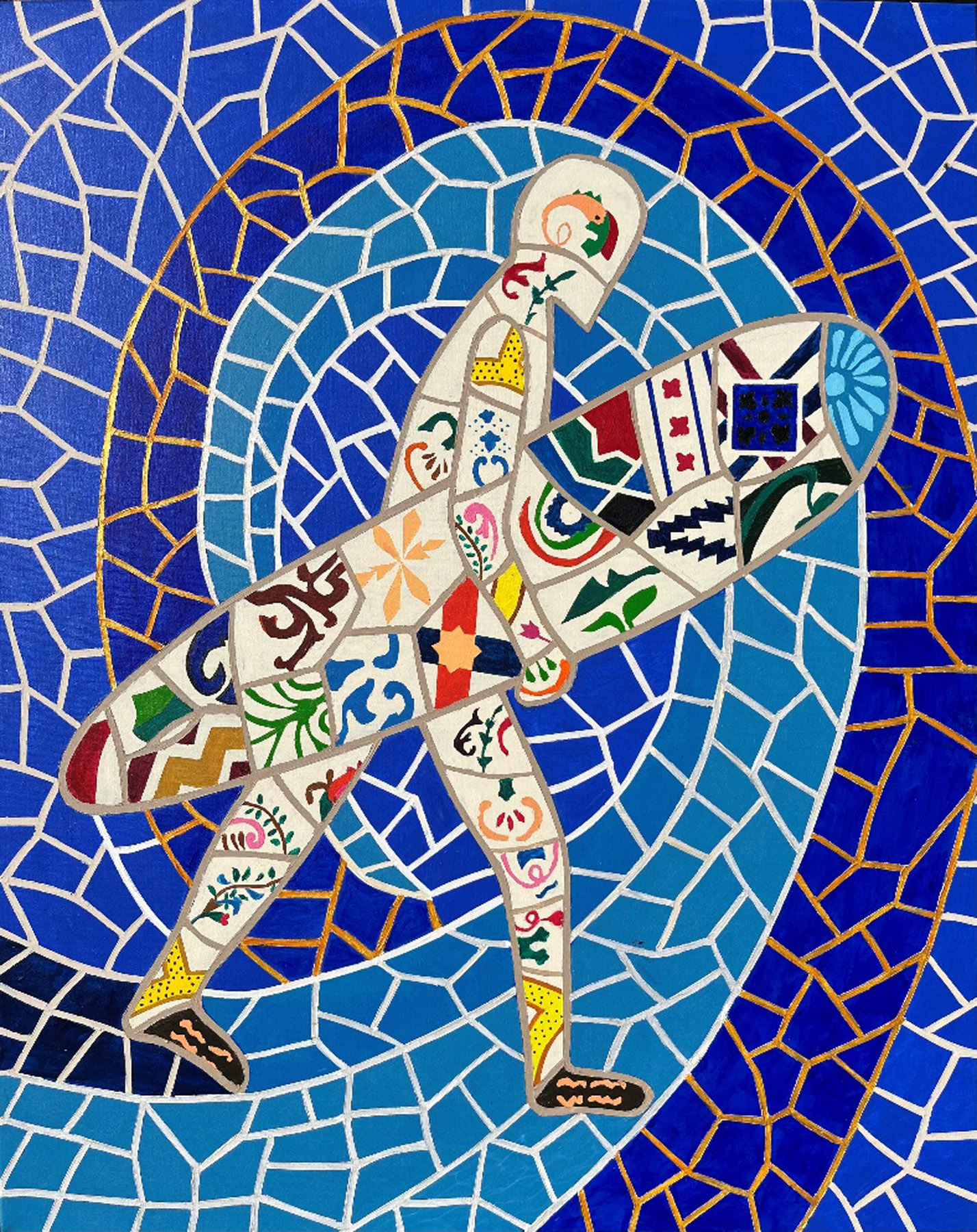
Surfista y ola
Técnica: Acrílica
Tamaño: 81 x 65
Año: 2024
Surfer and Wave
Technique: Acrylic
Size : 81 x 65
Year: 2024
Esta obra, ha sido creada mediante la técnica de “trencadís”, para rendir homenaje al surf y a su historia en España. Inspirada en la escultura de Mario García Fernández, es un tributo visual a Félix Cueto Serrano, el primer surfista documentado en el país, y a todos aquellos que se aventuran en el mar. La obra busca captar no solo la esencia de este deporte, sino también el legado y el espíritu pionero de quienes lo han practicado a lo largo del tiempo.
La obra se centra en capturar el espíritu de libertad y aventura característico del surf, así como la conexión profunda entre el ser humano y el poder de la naturaleza. La representación de un surfista integrado en un diseño mosaico complejo y colorido sugiere una búsqueda de equilibrio y armonía con el entorno natural, representado aquí por la ola. La figura del surfista, representada en una postura tranquila y clásica, evoca la elegancia y la serenidad que caracterizan a este deporte. La composición de fondo en espirales sugiere el flujo de la energía y el movimiento de las olas, transmitiendo así la fuerza y dinamismo del mar, a la vez que el respeto y la admiración del surfista hacia él. El surfista parece fluir con la ola transmitiendo la idea de adaptabilidad y de la importancia de “ir con la corriente” en la vida, permitiendo que las fuerzas externas guíen el camino, como hace el surfista en el mar
El surfista, hecho de múltiples fragmentos coloridos y patrones, muestra una diversidad de influencias y texturas, reflejando la riqueza de experiencias y emociones que acompaña a la práctica del surf. Los patrones decorativos de la tabla del surfista recuerdan elementos de diversas culturas y estilos, lo que puede sugerir una fusión de ideas y la universalidad de la relación humana con la naturaleza.
La obra transmite, sin palabras, un mensaje de fluidez, conexión y respeto hacia las fuerzas naturales. Los patrones y la disposición en mosaico evocan la idea de que cada parte es importante para crear un todo armonioso, simbolizando la integración de las experiencias personales en una aventura mayor
This work has been created using the trencadís technique as a tribute to surfing and its history in Spain. Inspired by the sculpture of Mario García Fernández, it is a visual homage to Félix Cueto Serrano, the first documented surfer in the country, and to all those who venture into the sea. The work seeks to capture not only the essence of this sport, but also the legacy and pioneering spirit of those who have practiced it over time.
The piece focuses on capturing the spirit of freedom and adventure that characterizes surfing, as well as the deep connection between human beings and the power of nature. The representation of a surfer integrated into a complex and colorful mosaic design suggests a search for balance and harmony with the natural environment, represented here by the wave. The surfer, depicted in a calm and classic posture, evokes the elegance and serenity that characterize this sport. The spiral background composition suggests the flow of energy and the movement of the waves, conveying the strength and dynamism of the sea, while also expressing the surfer’s respect and admiration for it. The surfer appears to flow with the wave, conveying the idea of adaptability and the importance of “going with the current” in life, allowing external forces to guide the path, just as the surfer does in the sea.
The surfer, composed of multiple colorful fragments and patterns, shows a diversity of influences and textures, reflecting the richness of experiences and emotions that accompany the practice of surfing. The decorative patterns on the surfer’s board recall elements from various cultures and styles, suggesting a fusion of ideas and the universality of the human relationship with nature.
Without words, the artwork conveys a message of fluidity, connection, and respect for natural forces. The patterns and mosaic arrangement evoke the idea that each part is important in creating a harmonious whole, symbolizing the integration of personal experiences within a greater adventure.